When browsing around looking for new and interesting puzzles I think that there is a real risk of thinking that great puzzles have to be accompanied by an epic price tag to match, but with this post I'm going to mention one of the many puzzles that I think goes against that idea.
This is the Tricky Gift Box, made and sold by the lovely people over at Oy Sloyd Ab in Finland. It is (almost) entirely made from simple birch wood, which may look a bit plain but it is actually a pretty tough wood which has a nice warm feel to it. Great for puzzles!
Looking over this box it is quite hard to see any place where it could open up. After closer inspection you should be able to work out where the lid is, but after that there seems to be no movement in the box whatsoever. If the box is empty then it will not make any noise at all when moved. Mine came with an old Finnish coin inside courtesy of Sabine at Sloyd as she thought I'd enjoy the puzzle more if I knew there was something inside that I had to get out. How right she was!
As puzzlers I think we can all admit to having a tendency to over-think puzzles on occasion, and this box really does play on that theory. Having given this box to a large variety of people it seems that non-puzzlers actually find this easier than puzzle veterans. Which is hilarious if you have both of those people at the same gathering working on it.
Another great thing about this box is that it is the perfect size to fit most modern mobile phones into, which makes it great fun at gatherings. Just ask someone to hand you their phone, shut it into the box (without them seeing) and then hand it back. Even better, put it down somewhere near them and give it a ring and watch them frantically try and work out how to get it out to pick up the call. I know this makes me sound a little bit cruel, but trust me, it is hilarious.
I think it actually took me something like 6-7 minutes to open this box, and once I had it open and saw the mechanism I was a little embarrassed with myself. Especially as I have now seen first time puzzlers open it straight after having it given to them.
For the price of 10EUR this puzzle is an absolute bargain! It's definitely not the nicest looking box out there, nor the most difficult, but it easily makes up for that with its simple charm. Head over to the Oy Sloyd Ab site if you fancy adding one to your collection.
Google Website Translator Gadget
Sunday, 4 December 2011
Tuesday, 29 November 2011
Alles Roger - Solved!
Finally, after many months and quite a bit of encouragement from fellow puzzlers I have managed to solve Alles Roger! Thank you to all of you who convinced me not to give up on it. And even a thank you to those of your who mocked me constantly for not being able to work it out. Although I remember who you are and I'll get you back eventually!
Alles Roger has a very devious solution, and despite it's obvious aesthetic resemblance to R2D2 (also by Roger) I can definitely confirm that it is nowhere near similar as a puzzle.
What a great design! It looks so simple and yet somehow it took me forever to solve. I know that it took some other puzzlers far less time to solve, so it could just be some kind of mental block that I had. But I really was starting to lose faith in this puzzle even being possible.
Alles Roger has a very devious solution, and despite it's obvious aesthetic resemblance to R2D2 (also by Roger) I can definitely confirm that it is nowhere near similar as a puzzle.
What a great design! It looks so simple and yet somehow it took me forever to solve. I know that it took some other puzzlers far less time to solve, so it could just be some kind of mental block that I had. But I really was starting to lose faith in this puzzle even being possible.
Sunday, 27 November 2011
Super Cubi (Hiroshi Iwahara)
This next puzzle box is perhaps one of the best known designs that is being manufactured by the Karakuri Creation Group in Japan.
Super Cubi was originally designed by Hiroshi Iwahara in December of 2000, and since then has been reproduced another five times, not including any special editions. If nothing else that shows just how popular this box has proven to be amongst puzzlers, especially considering the above average price.
This box is significantly larger than the average puzzle box made by the KCG, measuring in at 13.1cm cubed! And it has a pretty hefty weight to match.
Due to the extremely complex nature of the internal mechanism, several parts are machined from stainless steel. Although some may feel that this takes away from the traditional feel of the box I think that as it allows the box to become more complex, affordable and durable that it is a good addition.
Due to the large number of reproductions there are a lot of very different Super Cubis floating around out there. The version that I'm showing here is of the RF-4-3 design pattern, produced in August of 2007. All of the reproductions of these boxes have got nice but simple wooden inlay patterns on them, but they still make every side of the box look identical.
I can't speak for all of the design varieties as I have only ever held this particular one, but the box does feel incredibly sturdy. The outer panels themselves are around 5mm thick, and well connected to the internal mechanism by glued wooden joints and metal pins.
It will take you a total of 324 moves to open the Super Cubi, and then another 324 to close it again. Iwahara achieved this huge number by employing a trinary (or ternary) system into the mechanism. Hence why this box also goes by the name of the 'Trinary Box'. For a simplified example of this puzzle check out my review of Constantin's Fat Lock (Void Lock) puzzle.
Because I had a good idea of how the box worked I opened it pretty quickly. I say quickly, but really it did still take me quite a while (around 10 minutes) due to the very high number of moves. It could take significantly longer if you don't really pay attention to what you're doing. Lose concentration and you could end up closing it again rather than opening it.
The later versions of the Super Cubi were designed to allow puzzlers to 'speed open' the box due a more loosely constructed internal mechanism. Personally I prefer a more snug fit on my puzzle boxes.
I absolutely love this box, and it has easily become one of my favourite box designs. 324 moves is just enough to be considered very high but not so much as to put you off ever wanting to open it more than once. Although, last year Iwahara also designed the King Cubi (a.k.a: Quaternary Box) that takes 1536 moves! I look forward to seeing one of those!
Due to the large number of reproductions the Super Cubi can be found pretty much everywhere, and will normally set the puzzler back by around $800 to $1000. Definitely a lot of money, but if you like your boxes then you won't be disappointed!
If you are after one of these then check the usual places: Puzzle Master, Karakuri, PuzzleBoxWorld
Super Cubi was originally designed by Hiroshi Iwahara in December of 2000, and since then has been reproduced another five times, not including any special editions. If nothing else that shows just how popular this box has proven to be amongst puzzlers, especially considering the above average price.
This box is significantly larger than the average puzzle box made by the KCG, measuring in at 13.1cm cubed! And it has a pretty hefty weight to match.
Due to the extremely complex nature of the internal mechanism, several parts are machined from stainless steel. Although some may feel that this takes away from the traditional feel of the box I think that as it allows the box to become more complex, affordable and durable that it is a good addition.
Due to the large number of reproductions there are a lot of very different Super Cubis floating around out there. The version that I'm showing here is of the RF-4-3 design pattern, produced in August of 2007. All of the reproductions of these boxes have got nice but simple wooden inlay patterns on them, but they still make every side of the box look identical.
I can't speak for all of the design varieties as I have only ever held this particular one, but the box does feel incredibly sturdy. The outer panels themselves are around 5mm thick, and well connected to the internal mechanism by glued wooden joints and metal pins.
It will take you a total of 324 moves to open the Super Cubi, and then another 324 to close it again. Iwahara achieved this huge number by employing a trinary (or ternary) system into the mechanism. Hence why this box also goes by the name of the 'Trinary Box'. For a simplified example of this puzzle check out my review of Constantin's Fat Lock (Void Lock) puzzle.
The later versions of the Super Cubi were designed to allow puzzlers to 'speed open' the box due a more loosely constructed internal mechanism. Personally I prefer a more snug fit on my puzzle boxes.
I absolutely love this box, and it has easily become one of my favourite box designs. 324 moves is just enough to be considered very high but not so much as to put you off ever wanting to open it more than once. Although, last year Iwahara also designed the King Cubi (a.k.a: Quaternary Box) that takes 1536 moves! I look forward to seeing one of those!
Due to the large number of reproductions the Super Cubi can be found pretty much everywhere, and will normally set the puzzler back by around $800 to $1000. Definitely a lot of money, but if you like your boxes then you won't be disappointed!
If you are after one of these then check the usual places: Puzzle Master, Karakuri, PuzzleBoxWorld
Monday, 31 October 2011
Gathering For Gardner - Celebration Of Mind II (G4G CoM II)
Since 1993 gatherings have been held in order to honour the achievements of Martin Gardner. Martin is probably best known for his decades of work in the field of recreational mathematics, but his interests spanned many subjects including philosophy, magic and (unsurprisingly) puzzles. Check out these links if you would like to read more about Martin's fascinating life and the Gathering For Gardner Foundation.
Looking around the room it was hard to miss the huge bronze puzzle sculptures that although I instantly recognised as works by Miguel Berrocal I had never actually seen one in the 'real world'. These are probably some of the most beautiful works within the puzzle world, and they combine both puzzle and art in equal measure. Considering the rather hefty price tag on them I was very surprised to hear James encouraging me to take one apart. So I did! This one that you can see on the left was only comprised of about eight pieces, but it weighed an absolute tonne! It wasn't particularly difficult (even thought James helpfully scrambled up my neatly arranged pieces) but it was great fun to solve. After this James suggested that I try another, and of course I couldn't resist. So the next one that James took off the shelf was called 'Romeo & Juliet', and it was clear from the start that this one would be somewhat more difficult.
Later in the evening everyone settled down in the front room, and this was used as a time for everyone to give little presentations to the rest of the group. These could be on anything related to Martin, puzzles, magic, maths or a number of other subjects. There were some great talks on maze design, puzzle realisation and manufacturing, chess problems, text adventures etc. Including a couple of displays of magic! It was great to be able to meet and hear from people who have held these interests a lot longer than I have. The picture on the left shows Jeremy Goode giving everyone a talk on how he came up with the idea for his Xmatrix puzzles, and how they eventually became a reality.
Sadly Martin passed away last year, but he expressed a wish for the Gatherings For Gardner to continue and as such the 'Gathering For Gardner - Celebration Of Mind' carried on. This year was the second of these events to take place, and many gatherings were hosted all over the world on or around October the 21st, Martin's Birthday.
When I attended the 100th Camden Puzzle Gathering a couple of months ago I heard from fellow puzzler Laurie that this year James Dalgety and his wife Lindsey would be hosting a G4G CoM at their home, also known as the Puzzle Museum. Needless to say I was slightly more than enthusiastic to be a part of it.
It was a three hour drive to get to the Puzzle Museum, and actually finding the place was possibly the hardest puzzle that I had to solve over that weekend! If James hadn't put G4G signs out leading to his house I'd probably still be lost somewhere in the country.
Upon arriving I was greeted by several of the other enthusiastic attendees, some of which I had met before, but most were new faces. Then I was directed into the main 'Puzzle Room'. Words can't adequately describe my first thoughts upon entering this room, but hopefully this picture that was taken the next day will give you some idea:
My mind couldn't quite take in all of it at once. I was asked if there was anything in particular that I was interested in seeing, but when confronted this sheer magnitude of puzzles I couldn't think of anything!
I probably spent the first 20 minutes or so just looking around the room in all of the cabinets.
The majority of us spent most of our time around the table in this room, solving and chatting. Only occasionally did we wander out for some food and drink that was very kindly organised for us by Lindsey.
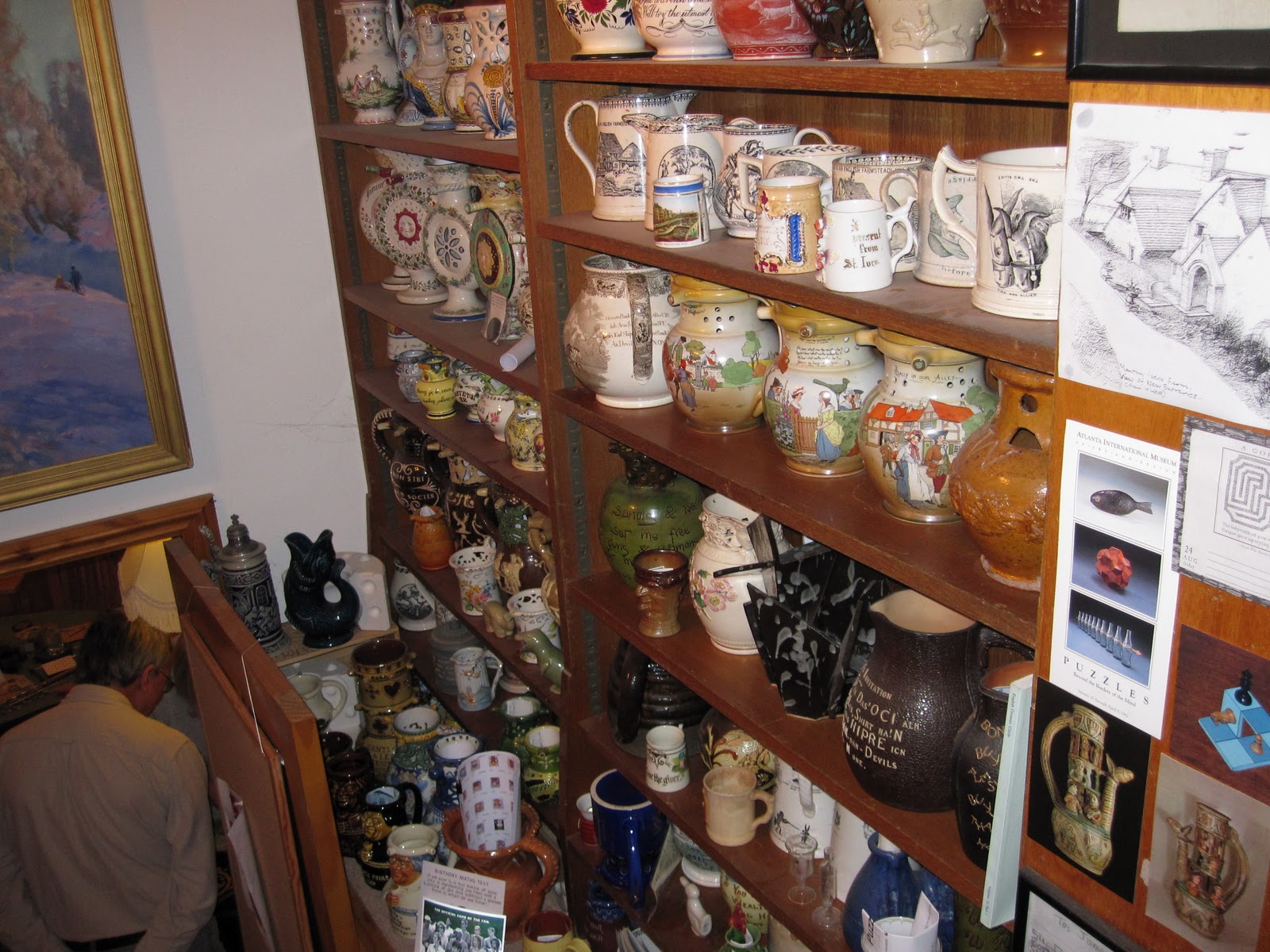
James did a couple of museum tours for people who hadn't visited before, so this was a good opportunity for me to see many interesting things that I perhaps would've missed if James wasn't pointing them out along the way. The room you see in the picture above is only one of several puzzle rooms, so it was easy to miss many things whilst looking around. Here are some of the things that I saw whilst being shown around the Puzzle Museum:
| Puzzle Library |
| On the ceiling |
| Categorised puzzle drawers |
| Impossible objects |
| Ivory puzzles |
| Puzzle jugs |
I can't possibly go into detail for everything that I saw and solved, but I will go through a few of the things which really stood out for me.
I was very happy to see the collection of beautiful anodised aluminium puzzles by Robert Rose (R.D. Rose). I have seen cheap copies of some of these puzzles, and the originals really do make the copies look quite terrible. The fit and finish on these puzzles is perfect, and the movements are very smooth considering that they are made from metal. It's really is such a shame that these puzzle are in such short supply as the demand for metal puzzles of this quality is extremely high.
Here is a cabinet that is stacked full of original geometric puzzles by prolific puzzle designer Stewart Coffin. I had only ever seen a couple of his original puzzles before, so it was quite an experience to see this many of them in one go. I didn't take any of them apart because I would've had to put them back together again, and knowing how difficult Stewart's puzzles tended to be I decided that it would be best to adopt the 'look but don't touch' attitude.
Edward Hordern was the agent to Frank Chambers, so he had all of his puzzle designs. Now as his entire collection was passed on to James they can be found at the Puzzle Museum. Frank made most of his puzzles from corian, which is mainly known as being used for kitchen worktops. I did get a chance to solve quite a few of them, and they are all really nicely manufactured with very clever mechanisms. Corian is a strange but very nice material, it would be great if other puzzle makers considered using it to realise their own designs.
After I had told James that my main interest was in puzzle boxes he took out a few of Akio Kamei's works from the cupboard for me to take a look at. Here you can see the Toaster, Radio and Parabox. The toaster I managed to solve after 10 minutes or so, but Parabox I just couldn't do in a reasonable time. This turned out to be a big issue, because although I hate leaving great puzzles unsolved, there were just so many to see and so little time to see them in, so on occasion I reluctantly had to move on. The Radio gave me quite a bit of a laugh as the solution was not entirely what I expected. And the solved state is a little...chaotic. It took a particularly 'elegant' touch from Laurie Brokenshire to get this one open, as I wasn't being quite 'elegant' enough. It turns out that this puzzle is much easier if you grew up in the era of valve radios, as Kamei's works designs tend to link up the aesthetics of the puzzle with the solution.
After being overwhelmed by all of the puzzle boxes in the cabinets, imagine how I felt when James mentioned that he had all of Kamei's boxes! As well as the shelves there were around six drawers full of them! I won't add all of the pictures here, but as always take a look at my G4G Photo Album where you will find over 100 photos from my very puzzling weekend.
There were more pieces.....a lot more pieces! And several of the pieces were hinged. I took this sculpture apart with not much difficulty, and then spent well over an hour trying to get it back together again. Laurie spent most of this hour supporting me by mocking my lack of progress. Jeremy Goode joined me for a while to try and fathom this puzzle, but still it remained unsolved. Because of the hinged pieces it had to be solved in a specific sequence, and I had to keep disassembling it in order to put new pieces in. Again (and this is the defence that I'm sticking with) this fell into the realm of 'puzzles I'm sure I would've solved if I had more time'. James eventually came over and mercifully gave me the solution book, and with that I managed to have it back together again after another 15 minutes. But it was still hard going! Laurie has photographic evidence of me reading a solution manual....I really do need to destroy that evidence at some point.
After the presentations everyone went back to chatting and puzzling. And as it was getting dark people were starting to head off home. I originally planned to leave at about 9pm to get home for midnight, but I lost track of time a bit and found myself still there well past 10. I didn't have anywhere else to be the next morning, so after a call to my ever understanding other half I took up the kind offer from James to stay the night. By this point only six puzzlers remained (including James), and we were up puzzling well into the early hours. This would normally mean a lie in, but as there were still one or two (or try 50,000) puzzles left unsolved, we went back to puzzling again. I spent a decent portion of the evening solving many of the Karakuri Christmas presents, which I have to say being a puzzle box lover I really enjoyed! I'll write up more about some of these individually in months and years to come, but pictures of them can as always be found in my puzzle photo album.
The next morning after breakfast we all spent some more time puzzling....for a change. James showed myself and Jeremy his incredible Scannavini Puzzle Cabinet, which is a real masterpiece of fine detail and workmanship, especially considering that it was crafted in 1870! Every aspect of it wasn't quite what it seemed. There were hidden switches, hinges and drawers everywhere. Follow the link above for a bit more information on the cabinet, including some really nice close-up shots of the intricate carvings.
Well, I know that I have missed out a whole load of interesting things from this event, but as this blog post was starting to look a wee bit long I've had to scale it back a bit. I honestly could go on and on about my visit, there is just so much worth mentioning and talking about.
I have to say a huge thank you to both James and Lindsey for inviting me to this event at their home, it was a wonderful experience that I will remember and most likely be talking about for a long time to come! And of course thank you to all of the other attendees who really made the weekend as interesting and entertaining as it turned out to be.
Like I've mentioned I haven't covered everything here, but do check out my G4G CoM II Photo Gallery for loads more puzzling pictures. And please do leave any comments/questions etc. using the comment thingy below this post.
Thursday, 13 October 2011
Magic Billet Box
This is a very solid puzzle box that I obtained quite a while ago now directly from the designer & manufacturer living in Oregon (US); Eric Krusen.
It is called the Magic Billet Box, and it is definitely not one of those puzzle boxes that you would be worried about someone breaking by accident. Here is a little about the box written by Eric:
The generic version of this box is plain non-anodised aluminium, but as you can see from my picture I decided to go for the black version. I thought it looked cooler, and it was also about $10 cheaper than the plain one. At first I was a little bit worried that the anodised colour would start to scratch and wear off over time, but I've had it for quite a while now and even though it has been puzzled over many times it isn't showing any signs of wear at all.
Looking at the puzzle to begin with it can be quite hard to find where the lid actually is due to the precision machined lid and dovetail sliders. One of the perks of getting the black version is that it makes the joins of the lid more difficult for the eye to see. Once you have worked out where the lid is it is pretty trivial to remove it completely. While doing so it isn't hard to notice that there are some very strong magnets at work in this little box. And once the lid is open you will still find yourself staring at a closed box. Very odd indeed. This is the main puzzle aspect at work here, and I have seen it confuse both amateur and avid puzzlers in equal measure.
The solution is simple and yet very satisfying. Even though it may be tempting to resort to lots of force it is completely unnecessary. Sadly I accidentally saw a video showing the solution to this puzzle, so I can't give an account of how difficult I found it, but judging by other puzzlers that I have seen pick it up it is not too difficult, normally not taking more than five minutes.
When ordering a Magic Billet Box you can specify from two different types of opening mechanism, and one of these requires an extra step compared with the other. If you were looking to own one of these and really wanted to enjoy solving it I would recommend you do not visit the site yourself and that you get someone else to order it for you making sure that they ask for the more difficult mechanism. Sadly the site shows pictures and video of the solution, which I'm not a fan of, and that is why I'm not including a link until the end of this post in order to give you guys the fair warning that I didn't have.
This puzzle is available from between $55 and $150. There are some really cool anodised and engraved versions available as well as the ability for you to request custom designs. All of these can be found on the dedicated site here: Magic Billet Box (CAUTION: THERE BE SPOILERS)
It is called the Magic Billet Box, and it is definitely not one of those puzzle boxes that you would be worried about someone breaking by accident. Here is a little about the box written by Eric:
"Our goal is to create a unique one-of-a-kind keepsake item CNC machine made from the highest of quality material where the end results will be a remarkable piece of art displaying the logo of your choice. We pride ourselves on the ability to personalize and detail these Magic Billet Boxes with such defined precision. These Magic Billet Boxes are extremely high quality pieces and will last a life time."And considering that all of these boxes are CNC machined from solid aluminium I'm pretty certain that he is right in saying that they will last a lifetime.
The generic version of this box is plain non-anodised aluminium, but as you can see from my picture I decided to go for the black version. I thought it looked cooler, and it was also about $10 cheaper than the plain one. At first I was a little bit worried that the anodised colour would start to scratch and wear off over time, but I've had it for quite a while now and even though it has been puzzled over many times it isn't showing any signs of wear at all.
Looking at the puzzle to begin with it can be quite hard to find where the lid actually is due to the precision machined lid and dovetail sliders. One of the perks of getting the black version is that it makes the joins of the lid more difficult for the eye to see. Once you have worked out where the lid is it is pretty trivial to remove it completely. While doing so it isn't hard to notice that there are some very strong magnets at work in this little box. And once the lid is open you will still find yourself staring at a closed box. Very odd indeed. This is the main puzzle aspect at work here, and I have seen it confuse both amateur and avid puzzlers in equal measure.
The solution is simple and yet very satisfying. Even though it may be tempting to resort to lots of force it is completely unnecessary. Sadly I accidentally saw a video showing the solution to this puzzle, so I can't give an account of how difficult I found it, but judging by other puzzlers that I have seen pick it up it is not too difficult, normally not taking more than five minutes.
When ordering a Magic Billet Box you can specify from two different types of opening mechanism, and one of these requires an extra step compared with the other. If you were looking to own one of these and really wanted to enjoy solving it I would recommend you do not visit the site yourself and that you get someone else to order it for you making sure that they ask for the more difficult mechanism. Sadly the site shows pictures and video of the solution, which I'm not a fan of, and that is why I'm not including a link until the end of this post in order to give you guys the fair warning that I didn't have.
This puzzle is available from between $55 and $150. There are some really cool anodised and engraved versions available as well as the ability for you to request custom designs. All of these can be found on the dedicated site here: Magic Billet Box (CAUTION: THERE BE SPOILERS)
Subscribe to:
Posts (Atom)